The ₹50 Lakh Dead-Stock Nightmare: Why Indian Nail Polish Brands Fail Before They Even Reach the Counter
Imagine this: Amit, a veteran cosmetic distributor based out of Sadar Bazar, Delhi, placed a massive order for 50,000 nail polish units with a local manufacturer. The samples looked stunning in the air-conditioned office.
But three months later, the horror stories started rolling in from retail counters in Kanpur, Lucknow, and Jaipur.
During the harsh North Indian summer, the pigment in the bottles separated into an ugly, oily layer. In the humid coastal markets of Mumbai and Chennai, customers complained the polish took forever to dry and chipped within 24 hours. Worse yet, thick sediment settled at the bottom of the bottles, making them completely unsellable.
Amit was left staring at ₹50 lakhs worth of un-piped, unsellable dead-stock, and his hard-earned market reputation went down the drain.
The Unseen Crisis in Indian Nail Polish Distribution
If you are a cosmetic business owner, wholesaler, or distributor in India, you already know that the beauty market is cutthroat. The consumer is highly demanding, but the biggest threat to your business isn’t the competition—it’s outdated factory technology.
Most local manufacturing units in India still rely on manual, guesswork-heavy production methods from the early 2000s. When factories use primitive machinery, you suffer the consequences:
- Batch Inconsistency: The shade “Ruby Red” you ordered in January looks completely different from the batch delivered in June.
- Weather Vulnerability: Formulations that flake, turn yellow, or thicken drastically depending on India’s extreme seasonal shifts.
- Leaky, Inefficient Packaging: Poorly sealed bottles that evaporate on transport trucks, leaving you with dry inventory and furious retailers.
In today’s market, relying on a manufacturer without advanced technology is like driving a Maruti 800 on a Formula 1 track. To build a highly profitable, sustainable cosmetic brand that generates crores in revenue, your products must be backed by modern, precision engineering.
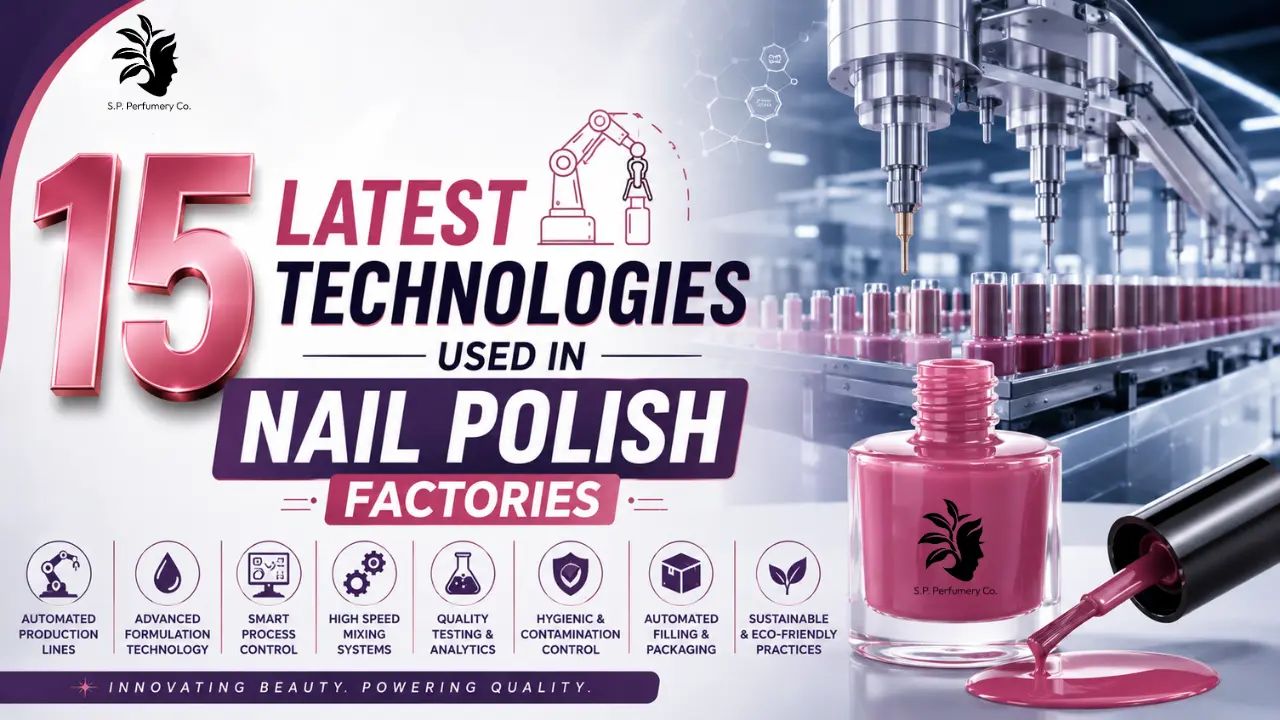
15 Latest Technologies Transforming Modern Nail Polish Factories
The world’s leading nail polish manufacturing facilities have evolved into high-tech chemical engineering hubs. To help you evaluate the capability of a true manufacturing partner, here are the 15 groundbreaking technologies used in state-of-the-art nail polish factories today:
1. High-Shear Bead Milling and Micro-Dispersion Systems
To prevent the pigment separation that ruined Amit’s inventory, advanced factories use high-speed bead mills. These machines grind color pigments down to sub-micron sizes, ensuring they stay perfectly suspended in the liquid formula for years without separating.
2. Multi-Angle Digital Spectrophotometers
Human eyes can misinterpret color under different lighting. Modern factories pass every batch through digital spectrophotometers that analyze the shade across multiple angles, guaranteeing 100% color consistency across 1,500+ distinct shades.
3. Climate-Resilient “All-Weather” Polymer Synthesis
India experiences extreme weather—from 45°C dry heat in Delhi to 90% humidity in Mumbai. Advanced factories utilize specialized thermo-stable polymers that adjust to local atmospheric conditions, ensuring the polish dries quickly and stays chip-resistant everywhere.
4. Automatic Multi-Head Volumetric Filling Lines
Manual filling leads to uneven quantities and messy bottle necks. Automated volumetric filling lines use pneumatic pistons to drop the exact milliliter of lacquer into every single bottle at lightning-fast speeds, completely eliminating human error.
5. High-Speed Nitrogen Flushing Systems
Oxygen is the ultimate enemy of liquid cosmetics inside a bottle; it causes the formula to thicken and dry out prematurely on the shelf. Automated lines flush the empty bottles with food-grade nitrogen gas right before sealing to remove all oxygen, significantly extending shelf life.
6. Automated Ball-Dropping Systems
Every quality nail polish needs mixing balls (usually stainless steel or glass) to help redistribute the lacquer when shaken. Modern assembly lines use optical-sensor-driven automated droppers that guarantee exactly one or two balls enter every single bottle without exception.
7. Dual-Stage Torque-Controlled Capping Machinery
If a cap is too loose, the product evaporates. If it’s too tight, the plastic neck cracks. Advanced factories use magnetic torque-capping heads that seal every bottle with mathematical precision, ensuring a 100% spill-proof and airtight seal.
8. UV-Vis Spectroscopic Stability Chambers
Before a formulation goes into mass production, samples are placed in accelerated stability chambers. These chambers simulate 3 years of intense sunlight, heat, and humidity exposure within a matter of days, ensuring the formulation never yellows or degrades.
9. Ultrasonic Bottle Cleaning and De-Dusting
Dust particles inside an empty glass bottle can cause tiny air bubbles to form when applied to nails. Factories use ultrasonic air-washers that blast ionized air into inverted bottles, vacuuming out every trace of micro-dust before filling.
10. Automated Vision Inspection Systems (Machine Vision)
Instead of relying on tired factory workers to spot defects, high-speed cameras integrated with AI scan bottles moving down the conveyor belt. The system instantly detects and rejects any bottle with a crooked label, hairline glass crack, or scratched cap.
11. Cold-Process Emulsification & Energy-Efficient Mixing
Older methods heated the base lacquer, which often damaged delicate color pigments. Modern cold-process mixers use advanced mechanical force to blend ingredients without heat, preserving pigment purity and saving immense manufacturing energy.
12. Smart Batch Traceability via IoT Sensors
Every batch of raw materials is fitted with a digital IoT barcode tracker. From the raw resin imported to the final carton sent to a distributor in Bengaluru, the entire journey is digitally logged, guaranteeing absolute accountability.
13. High-Performance Closed-Loop Solvent Recovery Systems
Industrial nail polish manufacturing involves volatile solvents like butyl acetate. Responsible factories use closed-loop condensation tech to capture evaporated solvents, clean them, and reuse them safely, heavily reducing environmental impact and keeping production costs low.
14. Modular Quick-Change Assembly Lines
Consumer trends shift rapidly—from mini 5ml travel bottles to heavy 15ml professional salon bottles. Modern factories use modular machinery that allows engineers to swap out filling heads and mold grips within minutes, enabling seamless switches between 1, 2, 3, and 4 Dozen packaging options.
15. Real-Time Viscosity Monitoring via Inline Rheometers
Nail polish must be neither too watery nor too thick. Inline rheometers constantly monitor the thickness and flow of the lacquer inside the main mixing tanks in real-time, automatically correcting the mix before it ever reaches the filling station.
“We Saved Our Network from Collapse”: A Distributor’s True Story
For Rahul, a major cosmetic wholesaler supplying to over 250 retailers across Madhya Pradesh and Maharashtra, choosing the wrong manufacturing partner almost ruined his family business.
“A few years ago, our retailers started returning stock because the nail polish brushes were fraying and dropping hair during application,” Rahul recalls. “It was embarrassing to face my dealers. I knew I needed to find a manufacturer who treated technology seriously.”
That’s when Rahul booked an in-person meeting with SP Perfumery Co. >
“When they showed me their automated production data and their precise vision inspection systems, I knew they were in a different league. They didn’t just give me empty verbal promises; they showed me data-backed proof. Partnering with them saved my network. Over the last three years, we have distributed their products across multiple states with zero quality complaints. Our business has never been more stable.”
Establish Lasting Market Success with SP Perfumery Co.
When you are pitching to large retail chains, dealing with a massive network of wholesalers, or scaling your own brand, you need a manufacturing backbone that never falters.
At SP Perfumery Co., we bring 21+ years of uncompromised manufacturing experience, with nail polish engineered as our core specialization. We don’t just supply products—we provide market-ready financial assets that build immense trust with your downstream network.
Why the Largest Distribution Networks in India Trust Us:
- Massive, Field-Tested Scale: We have successfully manufactured and sold 10+ Crore nail polish units, empowering our strategic partners to generate ₹200+ Crore in cumulative revenue.
- Unrivaled Product Variety: Dominate your local market with an incredible library of 1,500+ premium shades and 150+ innovative product variants across every major price segment.
- Seamless Logistics & Packaging: Whether your market demands premium boxes or traditional 1, 2, 3 & 4 Dozen commercial packaging options, our robust infrastructure serves 24+ States, 177+ Cities, and 211+ Pincodes through an active network of 13 master distributors, 250+ dedicated dealers, and 1,000+ wholesalers.
- The All-Weather Guarantee: Backed by advanced, scientifically validated all-weather formulations, our products remain flawless from the dry heat of Rajasthan to the humid shores of Kerala.
Let’s Look at the Data Together: Review Our Technical Blueprint
We do not expect you to buy into promises. We expect you to look at concrete engineering facts, batch records, and certified quality standards before you make a decision.
We invite serious brand owners, large-scale wholesalers, and corporate beauty distributors to sit down with our technical leadership team for a deep-dive business meeting. Let us show you exactly how our technology can secure your market share and maximize your profit margins.
Bring your toughest quality challenges, your specific regional color preferences, and your volume targets to the table.
👉 CLICK HERE to Request an In-Person & Receive a Custom Sample Kit. Let’s review the technical blueprints, test our formulations against your current stock, and map out a bulletproof supply chain roadmap that converts your market prospects into loyal, lifelong clients.