7 Top Questions to Ask Before Choosing a Nail Polish Manufacturer
A Strategic Guide for Cosmetics Business, Wholesalers, and Distributors in India
The Silent Business Killer in the Indian Beauty Market
Imagine launching a brand-new range of nail polishes right in the peak festive season. Your marketing team in Delhi creates stunning digital campaigns, pre-orders start rolling in from buyers across Mumbai and Bangalore, and thousands of customers eagerly unpack their long-awaited beauty purchases.
Then, two weeks later, the phone calls and refund requests start pouring in.
- “The paint is peeling off within 24 hours!”
- “The bottle cap broke during shipping!”
- “The shade in the bottle looks totally different from what was shown on the website!”
- “The nail polish turned thick, rubbery, and completely unusable inside the bottle!”
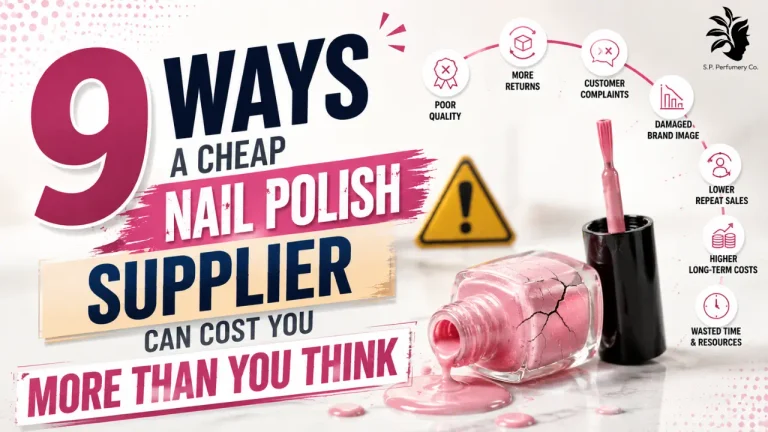
In the cosmetics business, product failure is not just a minor loss of stock—it is an absolute disaster for your business’s reputation. Whether you are a newly launched cosmetic label, an established wholesaler in Chandni Chowk, or a regional distributor scaling across Tier-2 cities, choosing the wrong manufacturing partner can quietly destroy your business overnight.
The Real Cost of a Bad Manufacturing Partner
When a batch of nail polish fails, you don’t just lose the ₹20 or ₹30 manufacturing cost per bottle. You lose far more:
- Dead Inventory & Blocked Capital: Lying on lakhs of Rupees in useless stock that no salon, retailer, or customer will touch.
- Crushed Retailer Trust: Distributors and wholesalers who spent months building retail networks will reject your future product lines.
- Severe Business Damage: Bad online reviews and negative market chatter travel fast in the Indian beauty community.
- Extreme Weather Vulnerability: India’s climate ranges from 45°C dry summers in Rajasthan to 90% humidity in coastal regions. Low-grade formulas separate, turn streaky, or dry up inside the bottle before even reaching the retail counter.
A Real Cautionary Tale: Priya’s ₹12 Lakh Lesson
Priya, a passionate cosmetic entrepreneur from Pune, wanted to launch a trendy 20-shade quick-dry nail lacquer collection. Eager to maximize her profit margins, she partnered with a low-cost, unverified contract manufacturer.
She placed an order for 25,000 bottles. However, during monsoon transit to distributors across Maharashtra and Gujarat, over 30% of the bottles leaked due to poor cap fitting. Worse still, the formula thickened into an unusable gel within 30 days. Priya suffered a direct financial loss of ₹12 Lakhs and lost major distribution accounts that took her three years to build.
How can you protect your hard-earned capital, retail network, and business reputation from such a nightmare? By asking the right questions before you sign a contract or transfer an advance payment.
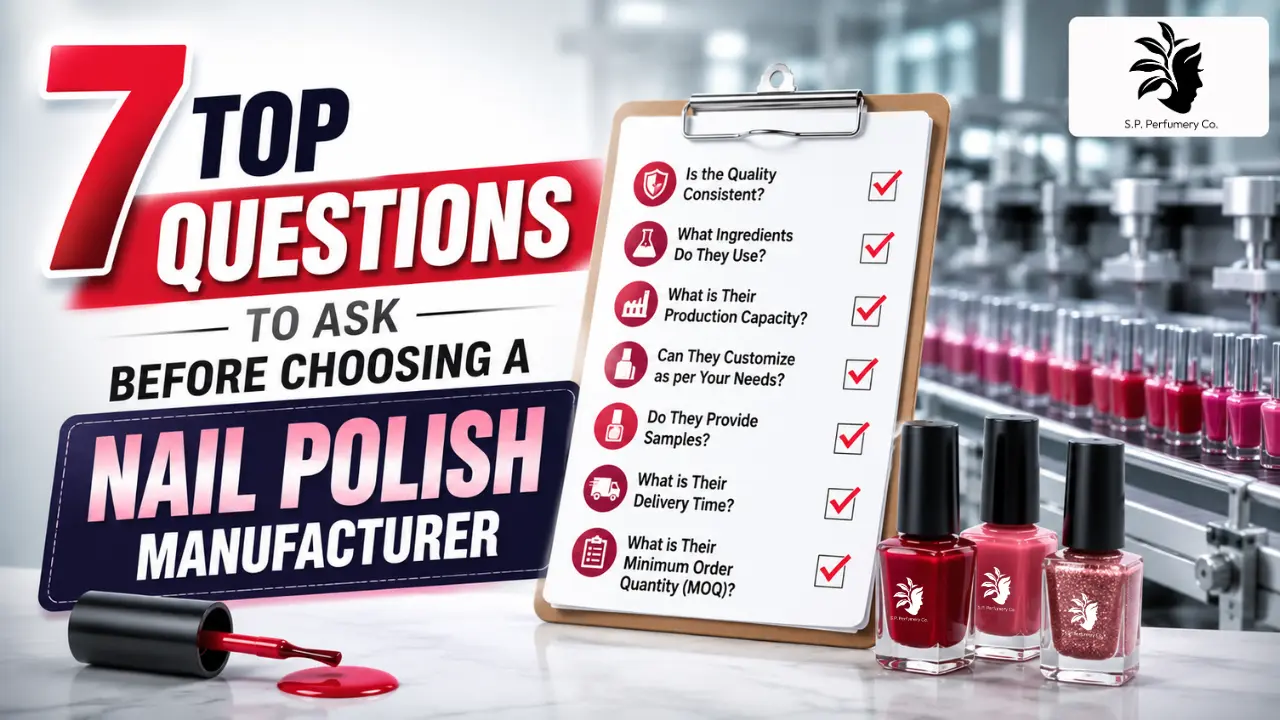
The Solution: 7 Critical Questions Every Indian Cosmetic Business Must Ask
1. “Do you manufacture all-weather formulations suited for India’s climate?”
India’s climate varies wildly across regions and seasons. A formula that works in cold climates might separate in North Indian summers or thicken in coastal humidity. Ask your manufacturer if their formulations are stress-tested for extreme temperature fluctuations. You need reliable, chip-resistant, non-yellowing, and smooth-flowing formulas that stay fresh on store shelves across all 24+ states year-round.
2. “How extensive is your shade library and variant availability?”
Beauty trends change overnight—what’s viral today on Instagram might fade in six months. If your manufacturer offers only 20 or 30 basic shades, your business will lose market share. Ask: Can you offer 500+ or 1,000+ shades? Do you have matte, gel-finish, metallic, glitter, pastel, and breathable formulations? A manufacturer with a vast ready shade library allows you to capitalize on market trends immediately.
3. “What flexible packaging options (Dozen packs) do you provide?”
The Indian distribution ecosystem relies heavily on traditional trade packaging. Wholesalers and regional dealers in cities like Ahmedabad, Kanpur, or Kolkata have distinct packaging preferences. Does the manufacturer offer standard 1 Doz, 2 Doz, 3 Doz, and 4 Doz box packs across budget, mid-tier, and premium price segments? Flexible packaging options help you cater to small retail shops as well as mega cosmetics distributors.
4. “What is your actual production capacity and track record in total units sold?”
Talk is cheap; proven scale is what guarantees supply chain security. Ask prospective suppliers about their long-term track record. Have they produced millions of bottles, or are they a small-scale setup struggling with scaling issues? A manufacturer with tens of millions of units produced has refined their quality control, bottle cap seals, and batch consistency to perfection.
5. “Can you support our growth from small wholesale orders to multi-crore expansion?”
Your business goals aren’t static—you want to grow. You need a long-term partner who can start with manageable minimum order quantities (MOQs) for market testing, but who also has the manufacturing infrastructure to scale seamlessly to hundreds of thousands of units as your demand surges.
6. “What proof do you have of helping partners generate long-term cumulative revenue?”
A trustworthy manufacturer is not just a vendor; they are a growth catalyst. Ask them about their client success track record. Have their manufacturing solutions enabled distributors and business owners to build sustainable, multi-crore enterprises? A proven partner will readily share client success metrics and market expansion proof.
7. “How robust is your distribution network and regulatory compliance?”
Navigating Indian retail logistics requires deep operational experience. Ask if the manufacturer understands the logistical nuances of shipping across thousands of pin codes. Ensure all products comply strictly with Indian cosmetic standards, FDA norms, and safety regulations so your business never faces legal hurdles.
Why India’s Top Cosmetic Businesses Trust SP Perfumery Co.
When you evaluate manufacturing partners against these 7 critical questions, SP Perfumery Co. stands out as an industry leader.
- 21+ Years of Core Expertise: Specializing specifically in color cosmetics and nail polish formulations.
- 1,500+ Shades & 150+ Variants: Giving you immediate access to India’s largest readymade shade library.
- 10+ Crore Units Sold: Delivering proven, market-tested consistency that customers trust.
- ₹200+ Crore Client Revenue: Empowering distributors, wholesalers, and business owners to build high-margin businesses.
- Nationwide Footprint: Serving 24+ states, 177+ cities, and 211+ pincodes through an elite network of 13 primary distributors, 250+ dealers, and 1,000+ wholesalers.
- All-Weather Formulations: Engineered specifically to withstand India’s diverse weather conditions without color shifting or drying up.
Partner Spotlight: How Shivam Scaled His Distribution Across 15 Cities
Shivam, a cosmetic distributor based in Jaipur, started working with SP Perfumery Co. under their flagship brand, Avlon International.
“Before switching to SP Perfumery Co., I constantly faced customer complaints about dried-up bottles and limited shade choices,” says Shivam. “With Avlon International’s all-weather formula and huge 1,500+ shade library, my return rate dropped to zero. Today, I supply over 250+ retailers across 15 cities in Rajasthan and Madhya Pradesh, doubling my annual sales.”
Ready to Build a High-Margin, Zero-Defect Nail Polish Business?
Don’t risk your capital, reputation, and business growth with unverified suppliers. Partner with India’s trusted color cosmetics specialist.
EXCLUSIVE B2B OFFER: Get a Nail Polish Sample Kit (Trending Shades in your area + Nail Polish Catalogue) and schedule a 1-on-1 Business Talk with our Cosmetic Product Experts today!