It starts with a promising sales pitch. A new cosmetics brand approaches you with flashy packaging, trending shades, and a heavy margin that looks almost too good to be true. You calculate the projected profits on paper, place a bulk order worth lakhs, and ship the inventory out to your network of dealers across Mumbai, Delhi, and Bangalore.
Then summer hits.
Within two months, the phone starts ringing. Kartik, a high-volume wholesaler from Chandni Chowk, calls to say the polish is separating in the bottles and thick liquid is clumping around the caps. Meenakshi, a beauty retailer in Bandra, complains that her customers are demanding refunds because the polish chips within 24 hours. Suddenly, your hard-earned reputation—built over decades of late nights and relentless market visits—starts taking hits over a product you didn’t even make.
The inventory sits dead on retail shelves. Your capital is tied up, dealers are hesitating to take your next dispatch, and the brand manufacturer is nowhere to be found when you ask for stock returns.
In the Indian cosmetics market, taking on a flawed nail polish range isn’t just a minor product failure—it can cripple your distribution cash flow and destroy the trust of your retail network.
To protect your distribution business and ensure every new line drives repeat orders, here are 9 critical things you must check before signing on a new nail polish range.
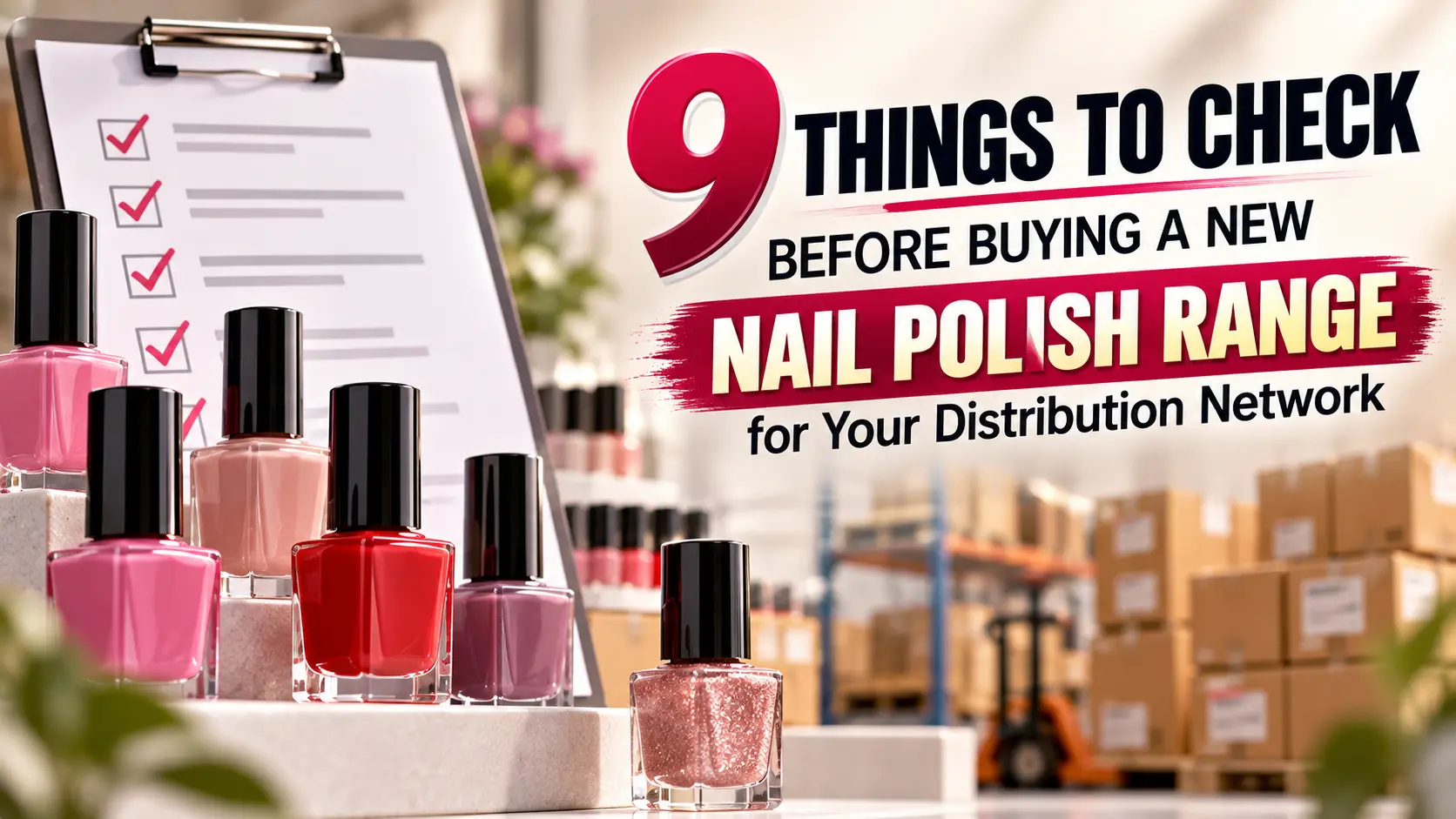
9 Things to Check Before Buying a New Nail Polish Range for Your Distribution Network
1. All-Weather Formulation Stability
India’s climate varies drastically—from the humid coastal air of Chennai to the scorching summer heat of Rajasthan and the freezing winters of the North. Standard liquid formulations often separate, dry out, or turn thick and goopy when exposed to temperature spikes. Before committing, ensure the nail polish uses a climate-tested, all-weather formulation that maintains consistent viscosity on the shelf for months.
2. Shade Palette Relevance to the Indian Market
A range featuring 50 variations of pastel blue might look stunning on Instagram, but will it move in Tier 2 and Tier 3 Indian markets? Indian skin tones and regional preferences demand a precise balance. You need a portfolio that combines evergreen bridal reds, maroons, and pinks with modern nudes, metallic gels, and seasonal pastels. Ask for evidence that the shade mix is driven by actual regional sell-through data.
3. Packaging Integrity and Leakage Prevention
Dead stock often stems from poor packaging. Check the bottle glass thickness, cap threading, and brush quality:
- Do the caps crack when tightened in bulk transit?
- Are the brushes cut evenly so application is streak-free?
- Is the inner seal tight enough to prevent evaporation on retail shelves?
If a bottle leaks during long-distance transport, it ruins the entire outer carton—and your profit margin along with it.
4. Flexible Packaging Configurations (1, 2, 3 & 4 Dozen Options)
Not every retail shop operates with the same purchasing power. A large wholesaler in Ahmedabad might easily take 4-dozen master packs, while a neighborhood beauty store in Pune wants 1-dozen or 2-dozen mixed assortments. A manufacturer that forces rigid, high-MOQ packaging options limits your ability to onboard smaller dealers and penetrate wider retail pockets.
5. Multi-Price Segment Coverage
To maximize distribution efficiency, your portfolio should cater to every pocket size. Relying on a single price point leaves money on the table. Look for a brand ecosystem that covers mass-market daily wear, mid-range salon finishes, and premium gel-look ranges. This allows your sales representatives to cross-sell multiple tiers to the exact same retail customer base.
6. Manufacturer Specialization and Heritage
Is the manufacturer a dedicated color cosmetics expert, or are they a trading company outsourcing production to third parties? Nail polish formulation is a fine science involving suspension agents, resin balances, and non-yellowing pigments. Partnering with a specialized manufacturer with decades of dedicated experience guarantees batch-to-batch consistency that generic traders simply cannot match.
7. Proven Network Track Record and Volume History
Before adding a range to your catalog, look at the manufacturer’s real-world footprint. Have their products sold in scale across diverse Indian geographies? A brand that has successfully moved crores of units across multiple states proves two things: consumer acceptance and production stability. You want a partner whose supply chain doesn’t choke when your demand doubles during the festive season.
8. Brand Ownership and Clear Business Model
Be clear on who owns the brand and what business model they operate. Work with companies that focus exclusively on building and supporting their own registered brands rather than dividing their attention across white-label or third-party OEM contracts. When a manufacturer is 100% committed to its own brand equity, their interests align directly with yours—protecting price integrity and market supply.
9. Genuine Product Sample Quality (Over Free Gimmicks)
Be cautious of manufacturers offering handfuls of free sample bottles. Often, free promotional samples are hand-picked from perfect initial batches, while bulk production quality drops significantly later. A professional partner provides paid standard samples for a nominal charge because they stand behind the commercial viability, finish, and durability of their actual shelf production.
Real Stories from the Field
“We moved ₹40 Lakhs of inventory in 6 months—without a single return.”
“Three years ago, our distribution business in Uttar Pradesh hit a wall with constant product drying complaints from a local polish brand. We switched to SP Perfumery’s registered brand portfolio, starting with their 2-dozen retail packs. The all-weather formulation completely solved our shelf-life issues. In six months, our dealer network expanded from 40 to over 110 outlets across Kanpur and Lucknow, generating over ₹40 Lakhs in sales with zero product returns.”
— Vikram, Master Distributor
“From a single counter to 250+ wholesale accounts.”
“What impressed us most was the shade variety and packaging options. Having access to over 1,500 shades allowed us to cater to both wedding bridal demand and daily office wear trends in Bangalore. The profit margins are predictable, the delivery is rock-solid, and our retailers actively request reorders every fortnight.”
— Sanjay Mehta, Regional Wholesale Partner
Partner with India’s Core Nail Polish Experts
Navigating the cosmetics market doesn’t have to mean risking your hard-earned capital on unverified lines. At SP Perfumery Co., we bring 21+ years of manufacturing specialization dedicated to the nail polish category.
We don’t do white-label or OEM manufacturing—we focus entirely on building and backing our own 10 registered brands so our distributors enjoy complete supply reliability and market protection.
- Massive Portfolio Choice: Over 1,500+ trend-tested shades and 150+ product variants across every major price segment.
- Flexible Retail Packing: Convenient 1, 2, 3 & 4 Dozen pack options designed for easy dealer distribution.
- Proven National Scale: Trusted across 24+ states, 177+ cities, and 211+ pincodes, supporting a network of 13 distributors, 250+ dealers, and 1,000+ wholesalers.
- Unmatched Market Performance: Over 10+ crore nail polish units sold, helping our network partners generate ₹200+ crore in cumulative revenue.
If you are a distributor, wholesaler, or cosmetic enterprise looking to expand your business with high-velocity, climate-tested nail polish ranges that drive repeat orders, let’s talk.
Ready to evaluate the range for your network?
Order our official Distributor Sample & Shade Kit for a nominal charge today. Test the finish, inspect the packaging, and evaluate the quality firsthand before making any bulk commitment.
Click Here to Request Your Distributor Kit & Regional Catalog
Connect directly with our sales team via WhatsApp or Call to discuss distribution rights for your region.
📞 Call / WhatsApp: +91 88105 67775